Showing posts with label news. Show all posts

Thursday, November 8, 2012

Fly to Faustus!

A short and urgent post, kind readers.
I'll begin by recalling the inscription that appears on Faustus's arm after he signs away his soul: "Oh man, fly." 
Faustus wonders "whither" and even if he can fly, but you shouldn't have to suffer from the same directional despair. 
I know exactly where you should go: the movies.

http://www.screenvision.com/cinema-events/doctor-faustus/

I've JUST THIS SECOND returned from seeing the Globe's production of Dr Faustus on screen. That's right, The Globe
Dr Faustus is one of my favorite plays to read, but seeing it (especially with a friend who studies Early Modern drama) has sent me over the moon.

Some points of extraordinary awesomeness:
- Mephistopheles: portrayed differently from how I read him, but the actor is so compelling, so moving, so authentic, even, that I found myself nearly overcome by his performance. 
-Robin: I usually skim the comic interludes, but the actor who plays Robin is simply brilliant. 
-costumes: right for the stage of the Globe, the costumes are period-appropriate with the perfect amount of contemporary ingenuity. 
-props: fantastic-- a couple of elementary magic tricks, a few trap doors, and some damn-near-War-Horse puppets take advantage of the setting without getting carried away. (nb: COOLEST DRAGONS EVER).
-it's the feckin' GLOBE, yet the director for the screen is as gifted as that for the stage. This was no "stick a tripod in the corner" production. The camera gives great balance between zooming in and letting us see the stage as a whole; watching it on screen didn't feel inorganic or forced.

The next **and only other** showings seem to be on November 13. 
You can look for screenings in your area here:


Until next time, readers, may you fly closer to the theater than to the sun


Friday, August 24, 2012

On Beowulf, Unferth, and the Lance scandal


I was lucky to begin teaching my first literature sections with Beowulf and some smaller Anglo-Saxon poems this morning. Teaching at 8 and 9am can be rough, but the students can be quite promising—they are, after all, those who signed up for class at 8 or 9am. And yet, not all of them are the go-getters that we’d all love to teach; some are the slack-asses who forgot to look at their sections, or who registered so late that they ended up here on accident. There’s really no telling what will happen.
I was THRILLED by my 8am class. It started slowly, as it should, but an attentive and interesting group emerged as the time passed. I got some thank-yous and follow-up questions at the end, which bodes well for a group of curious students.
Beowulf manuscript

My 9am class was brutal. Very few were responsive; very few were engaged; many looked annoyed. None of my warm-up strategies worked—it was difficult to get them to talk about what they didn’t like in the poems and impossible to get most of them to loosen up, chuckle, or seem engaged. Of course, there were the “happy few” who jumped in, but the vibe was all wrong.
And I didn’t help myself, either. After asking them to find an example of synechdoche (which I mispelled on the board), I waited through a few minutes of predictably awkward silence. When I broke it, I pointed out that no one could find anything because no one had marked in the book; I explained that reading without reading actively was a waste of time. I showed them my oh-so marked up text, and we all agreed that it’d be easier for me to find an example because of my annotations.
A hand went up.
I called on its student, who asked:
“Can you find an example for us?”
SURE I CAN.
Shit.
So much for establishing my credibility in a class full of skeptics!  I actually ended the class with, “Well, I hope your weekend will be better than your morning.”
UGH.

Thankfully, a thoughtful student came up after class with a question she’d brought up in an email. She asked why, in a warrior society like Beowulf’s, Unferth’s envy of him was so big a deal. Competition drove much of their culture, so why was the man who challenges Beowulf portrayed as such a bad guy?

Some brief background: when Beowulf arrives in hopes of killing Grendel, he introduces himself with a series of boasts to 1) establish his lineage and identity, and 2) show justification for the Danes to trust him. An introduction like, “Hey, I’m Beowulf. I’m soooooo good at what I do—I’m such a badass. I’ve killed tons and tons of creatures because I’m awesome. By the way, my family tree is ridiculous. Do you know who my dad was?!” is a bit off-putting to contemporary readers, but one can see the usefulness of the verbal CV to a community plagued by invasion.
Sea monster on Viking longship

In any event, when Beowulf arrives, Unferth is a bit moody. In Seamus Heaney’s words, Unferh “spoke contrary words” because he was “sick with envy” when he suggests that Beowulf’s swimming match with Brecca was motivated by vanity rather than glory. Moreover, Unferth protests, Beowulf didn’t win the race as he claims; Brecca “made good on his boast upon you and was proved right.”
Beowulf responds by bringing something new to the story—sea monsters. He claims to have killed nine of them in the race and, marked by fate, was shown to be the stronger swimmer. Rendering his opponent’s rhetoric as silly, childish brattiness, Beowulf notes: “The fact is, Unferth, if you were truly as keen or courageous as you claim to be Grendel would never have got away with such unchecked attrocity, attaks on your king.”
Can you feel the sting?
It seems, then, that competition is important to Anglo-Saxon society and their continental kin, but equally important is what we might call sportsmanship. If someone beats you, fine—give him the gold (or horses, or kingdom, or whatever) you promised and get on with it. There’s very little room for bitterness in a world so marked by interdependence and so desperate for safety. Yes, the hero gets the goods, the fame, the earthly (and perhaps heavenly) glory, but that’s something to celebrate and, even more importantly, something that is likely to benefit the entire community.

But is this the same today? When I saw that Lance Armstrong had given up his fight against doping claims, I wondered if he’d been just run down by thousands of Unferths bitter about his successes and their own weaknesses. But perhaps they are right; there’s certainly some evidence of Armstrong’s drug use. As an ex-runner, I’m still upset by Marion Jones’s abuse; I had looked to her as a great female role model. As an Austinite who saw Lance bring together a community, open up the sport of cycling, and help my friend dying of cancer, this news is even more upsetting. 

If, like the Anglo-Saxons, we benefit from our heroes’ successes, in what way to we reap the reward? If they don’t compete for fame, for glory, why do they compete? More importantly, for whom do they compete? Don’t they know the risks their taking with our trust, our pride, and our support? Does unity forged in a lie keep its bonds, or will it unravel with the truth?
In this literature, the hero is welcomed and rewarded by the community he helps to save or he is buried by those he fails. In either case, there’s no cheating—especially not fate. 
Gold from Staffordshire Hoard


Sunday, March 18, 2012

On thingness and stories

News Headline and corresponding mini-article, via iPhone, via Twitter, via Gawker:

Encyclopaedia Britannica Dies Under Its Own Massive, Printed Weight
Alas, yet another sign that yet another era is ending. The New York Times is reporting that after 244 years, the Encyclopaedia Britannica is going out of print. While it's easy to imagine that we'll survive just fine without it—in this age of Wiki everything—we also know that life will never be the same. Now knowledge-starved children will be tasked with googling something to learn about it rather than turning to those beautiful, if obscenely heavy, bound volumes. (That gold lettering! The randomness of topics allowed by alphabetical entries!) Nevertheless, all is not lost. We will still have online access to the rock solid information once contained in the encyclopedias. Though until they find a way to recreate the experience of holding the weighty tome in one's hand and inhaling the almost ancient smell of the Encyclopaedia Britannica through your electronic device, we can still rightly sulk about the death of these classic books.


And here's an excerpt from another article on the encyclopedia's crash, written by a former employee of Britannica.com for Inside Higher Ed:


[Explains, somewhat long-windedly, the reason for the failure]
Those of us who work in higher ed will need to make many transitions to stay relevant in an increasingly global and digital economy. We will have good ideas about how to evolve traditional higher education away from the bundled, place-based, discipline centric institutions that we ourselves were educated in, have spent our lives working for, and that we love. Our success in evolving our institutions, however, will not be determined solely by our ideas for change - but instead by our abilities to execute on these ideas. Will we have the wisdom and skills necessary to evolve our institutions in a global, digital economy?
The rest of the article here.


Although I didn't love the article, I could relate immediately to its points.  At the cartography workshop hosted by GlobalWork(s) Lab, we discussed the frustrations of having ideas about mapping projects but lacking funding, access, and programming help. Many of us were trying to bring the humanities into digital media but felt like we needed a degree in computer science.  Our interests are interdisciplinary, but are skills are not. Even more attendees-- especially faculty-- brought up issues of funding, availability of faculty or student support, pressures of tenure, whether or not a project could count as a publication, and what happens if a project fails.  This rather promising conversation came at the end of the day, so very few answers were put forward, but I was relieved to know that I was not alone as someone flailing about and failing to cross borders between fields.

Not mentioned in the workshop, but something I find rather fascinating, is the exhibit of Salman Rushdie's Archive (ended in 2010).
From the curator:
A World Mapped by Stories showcases Rushdie’s belief that reality and the world leave a lot to the imagination, committing the vigilant writer to the task of mapping. For Rushdie this involves a global mindset, creativity with a strong historical sense, the integrity to defend multiple worldviews, and the courage to “point at frauds.” Mapping captures Rushdie’s philosophy of engagement with a storied world, the writer’s creative role in shaping it, and the importance of guarding the freedom to do so. Borrowed from Rushdie’s account of his travels with writer Bruce Chatwin, the title of the exhibition offers a simple but profound message: stories are powerful because we know the world through them. Rushdie’s stories reinvent a world made cynical by injustice and suffering.
Article here.
Elaine Justice quoted Richart E Luce in her publication about the exhibit:  
"The Rushdie archive signifies two major trends of our time: the globalization of arts and letters, and the digital world in which contemporary writers and artists, such as Mr. Rushdie, are now composing their masterpieces."
Article here.

Yet through the constant talk of future digitalization and present globalization, a voice speaks up for the artifacts of the past. Physical objects matter, perhaps now more than ever.

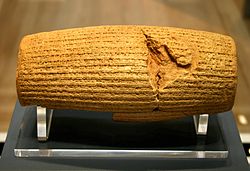
In July of 2011, Neil MacGregor (author of A History of the World in 100 Objects and Director of the British Museum, nbd) spoke at TED about a 2600 year-old, cuneiform-inscribed cylinder as "a powerful symbol of religious tolerance and multiculturalism." I would have included words like "site" and "memories" in the little blurb, but oh well.  I highly recommend watching the talk:
http://www.ted.com/talks/neil_macgregor_2600_years_of_history_in_one_object.html


It's a rather large, heavy object.  Daunting and illegible to the vast, vast majority of us, it hosts stories spanning over two and a half millennia; its meaning has been made and remade through its inscription and provenance. As an object, as a thing, the cylinder tells a story of civilization.  Its voice rings out, perhaps ironically, via my laptop, via google search, via the website of TED--short for Technology, Entertainment, Design.


Wednesday, March 7, 2012

Miscellany and Money

It has been too, too long since my last post.  Some updates:
I'm still mapping
My sisters, husband, brothers-in-law, and I surprised my dad for his 70th birthday in Austin thanks to the mad coordinating skills of my stepmom, Heather

For those of you interested in the intersections between digital and print worlds, here is a link about the "listsicle" of Thomas Nashe, who wrote in the late sixteenth-century on "Eight Kindes of Drunkennes" Listsicle Article

For those curious about how exercise can "change your DNA"-- can you smell the spin?-- check out this little ditty about what we already know: working out is the best thing ever, and people who don't do it are lame. Feeling guilty? You should!


[skip transition] I've noticed-- in news and in recent articles floating about my laptop-- an increased curiosity in changing perceptions of wealth.  For instance, Mitt Romney seems rather unapologetic about his gazillions, and his wife doesn't consider herself wealthy at all (see abc article here). 
Mitt and Ann Romney, image from The Telegraph
ARE THOSE PEARLS REAL?
But according to Michael Dean Crews, The US would not be the first nation to pull extraordinary wealth from the flames of socio-religious condemnation.  In his master's thesis, he examines "the various ways that the perception of bankers and banking in Florence changed from the 13th to the 15th century" within "three categories, scholastic attitude, law, and public image, and utilizes a socio-intellectual style of historical inquiry."  
He continues:
Dante in Florence
"The purpose of this study is to demonstrate that the positive acceptance of banking from a formerly profane vocation was due to a more advanced understanding of industry and economics, a more relativistic interpretation of theological and juridical sources, and an aggressive campaign by the humanists to redefine moral values and to reshape the Florentine culture and urban landscape in order to bring esteem and power to the elite bankers. " The rest of the article is here.


Sounds familiar, no?  Allow me to be clear-- I'm passing no judgment on Romney or the Florentine bankers; I'm only drawing a parallel.  

Yet banking isn't the only arena to benefit from the reworking of wealth's righteousness.  In 2007, John R. Black published an article called "Tradition and Transformation in the Cult of St. Guthlac in Early Medieval England" in The Heroic Age: A Journal of Early Medieval Northwestern Europe.  In it he finds that: "[a]nalysis of the variations introduced into the hagiographic corpus, both textual and iconographic, for a saint’s cult over the course of the medieval era demonstrates the vitality of that corpus, reveals the cultural significance of the variations introduced, and offers insights into (re)conceptualizations of sainthood." 
St Guthlac and Demons, Guthlac Roll (13th century)
Fascinating? Yes. Relevant to this post? Almost.  
Here's the good part: "Such analysis elucidates, for example, the ‘evolution’ of St. Guthlac from ascetic solitary to promoter and defender of a wealthy religious establishment." Article here.
I wonder, then, if the Republican voters, and later, the larger body of American voters, will reorder the narrative of Romney's wealth (if they need to).  What other forms might his money-making take in the public eye?

Until soon, patient readers!

Monday, December 12, 2011

Miscellany, wishful thinking, and a teaser or two

Hello again, and sorry for the hiatus.  I should be back in full once-weekly-post swing in a week or so.
My next post will likely be about historiography, insularity, and dinosaurs; I hope to follow it with reflections on attending the UNC-UT basketball game with my parents, hosting my in-laws for Christmas, and taking a New Year's trip to Galapagos.

While working through my last week of this semester, I've increasingly missed blogging.  Instead of putting it off until I could write a longer piece with in-text citations and everything, I thought I'd take advantage of the urge to write and shoot for  a shorter post.  Several topics have come to mind-- the background of Christmas traditions, the Jesus v. Santa dialogues, the UN climate talks, and various, public moments of extraordinary bravery, but I don't have as much time to spend on them as I'd like.

So, I'll spend what little time I have on myself-- and you, hopefully-- by sharing some Christmas wishes:

1. (you knew this was coming) That at least one of my friends sponsors, fosters, or adopts a shelter pet. Read common misconceptions about shelter pets here, but know one thing: I am pro-adoption, not particularly anti-breeder.
2. That some trees are spared by people wrapping amazing gifts are in even more amazing gift-wrap scarves, like this (there are totally awesome, less expensive alternatives as well).
3. That Santa, whoever he may be, drops the keys to my #1 gift of all time down the chimney.

I've provided some scholarly links, some news articles, and a bit about dogs.  It seems, then, that I've got no excuse for not returning to my schoolwork.

Until soon,  friends.

PS: Today is the last feast day of Our Lady of Guadalupe-- a tradition I hope my grade / middle school in Austin keeps up.  Vive la virgen!  (google for more info on a great story; NPR had a very cool interview with a Franciscan friar on the topic, as well)

Friday, December 2, 2011

Values of the Hidden

You might have heard about the Carrier IQ app that "logs text messages, dialed calls, URL searches and more -- all without the user's knowledge" (Gilbert).  If you haven't, you can read about the online exposure and the response in this article.  In strikingly similar news, Ally Bank is tracking users' locations as well, because "[i]n these economic times, financial institutions like banks are looking for extra revenue sources" (Yoo, in Kavoussi of HuffingtonPost).  Both phone carriers and the bank, though, failed to tell clients that they were being tracked.  I know, I know. We're all appalled.  But are we surprised?
There's been a lot of political talk about the rights of corporations lately, and given what we know about Google and Facebook privacy, we might not be as shocked as we'd wish.  
"Outrageous!" I find myself thinking.  "They've got no business tracking my whereabouts, purchases, texts, and searches."  And yet, it is just that-- business. So what does this mean for the -- dare I use scare quotes-- "individual"?  
It means that we've become commodities; it means our secrets have become commodities.  What we do with our time, in our homes, on our phones and computers, has become valuable to others, to strangers, to anonymous and autonomous corporations.  How did this happen?  Whose fault is this? What can we do?  And importantly, on what do we base our assumption that we can, and indeed should, hide what we've been doing from these faceless, nameless, number-crunchers?  What is the value of a secret?
Lelio Orsi, 1555
I recently turned in a paper about what I call the "Economy of Secrets" in two of the Canterbury Tales.  I spent most of my time on what editors usually call "The Second Nun's Tale," which is based on the legend of Saint Cecilia, who seems to come from the 5th or 6th century.  Like so many saints' legends, hers is the story of her virgin martyrdom at the hands of persecuting Romans.  
On her wedding night, she tells her husband that she has a secret.  He's fine with that, and promises his discretion in exchange for her revelation.  "I have an angel who protects me from anyone who would love me uncleanly (physically)," she responds.  Rightfully skeptical, her husband Valerian tells her that he can't see an angel, but if she will show him the creature, he will do as she wishes.   Cecilia replies that he must be confessed and baptised in order to see the angel, and his conversion sparks a series of events that allows her to convert the hearts of countless others until her martyrdom.
Although I began my research looking for ways in which the body was valued, and how that value might have related to the narrative strategy of the original legend and Chaucer, I ended up discovering something else: the secret has extraordinary purchasing power.  In a way, the whole story is set in motion when she trades her secret for his confidence.  After converting her husband and his brother (who are martyred for their belief in the middle of the story), she is also brought into the authorities for practicing Christianity. Although her faith has been revealed, the public interrogation provides her with a last (and her largest) audience to convert.  Ultimately she gives her life-- her bodily life, anyway-- to turn pagans  into Christians, and Pope Urban takes her body away in the night to bury it in secret.  On the hallowed ground of her hidden body he builds a church, which according to the legend still inspires worshipers.  
Her body becomes the secret-- the object valued as something once hidden, now revealed.
It seems, then, that we've had a preoccupation with the powers of secrets for quite some time.  Although the situations are quite different, both my newsfeed and this saint's life demonstrate the inherent value of secrets to outsiders and the power of disclosure.  And yet, when Cecilia's story narrates a series of exchanging secrets, our current story tells a far different tale.  What do we receive in exchange for our browser history, or GPS use, or MMS? Is ours the narrative of a zero-sum game rather than trade? Whether for profit, salvation, or persecution, we endow great value in secrets.  But given the current stakes, will we ever see a return on this investment?

Thursday, November 10, 2011

On Chaucer's Pardoner and Joe Paterno

In The Canterbury Tales, our dear friend Geoff Chaucer tells the story of others telling stories (about others).  It's a text rich in material for study, especially on narration and authority.  One of the most memorable characters/narrators is the Pardoner, a man whose job is collecting extorting money from penitents.  The Pardoner introduces his tale with a confession, admitting that he is a phony driven by avarice and listing some of his most egregious misdeeds, including peddling false relics.  His actual tale is a story that illustrates how destructive avarice can be, so this confession ultimately builds his credibility as its teller, establishing him as an expert on the issue.  But the sticking point for so many readers (and scholars) is the claim that links his confessional prologue to his tale about three greedy thieves seeking Death:
"For though myself be a ful vicious man,
A moral tale yet I yow telle kan" (460, 461 in Bevington).
He knows that he is a "vicious man" yet maintains that he can tell "a moral tale."  He's been perfectly up-front about his cheating, stealing, and ostensibly unrepentant self, so it seems unlikely that he'd lie in this instance.

I find myself trying to redeem the Pardoner here.  "He's at least honest; that's a start," I say.  But is it?  What happens when someone who does bad things does something good? Do we always see these notions as either withdrawals or deposits into our human-ness account, looking for good deeds to undue past cruelties, and expecting all our meannesses to undo that volunteer work we did in high school?

Regardless of the speaker, what's at stake here is really the difference between being a good person and doing good things.  We all think, say to ourselves, say to our loved ones, "good people can do bad things, and bad people can do good things."  This is certainly convenient.  But what this assumes is that what a person is, fundamentally, is static.  To assume that a good person can do bad things doesn't seem to account for the possibility of transition from "bad person" to "good person"-- or any mutability or boundary-blurring between.  One simply is good or bad, and is allowed (even expected?) to deviate from time to time.

How easily we as students, teachers, parents (of pets or people) hear and say that we meant better, that we're really not like that, that our actions this one time define or express us less than better moments.  Are we so involved in a culture of disclaimer that we can't even fathom being a bad person, if only for a moment?  And is it so impossible for someone to be bad one day and good the next?  Why must we couch all devious actions in the context of our personhood?  When do actions speak for themselves?

I saw the resurgence of a Taylor Mali poem about conviction on Twitter last night.  The youtube clip is here, and I encourage all to check this, and his other work, out frequently and thoughtfully.  Here is an excerpt from the poem that examines a trend of decreasing responsibility in writing and speech (my favorite bits are in bold):


What has happened to our conviction?
Where are the limbs out on which we once walked?
Have they been, like, chopped down
with the rest of the rain forest?
Or do we have, like, nothing to say?
Has society become so, like, totally . . .
I mean absolutely . . . You know?
That we've just gotten to the point where it's just, like . . .
whatever!
And so actually our disarticulation . . . ness
is just a clever sort of . . . thing
to disguise the fact that we've become
the most aggressively inarticulate generation
to come along since . . .
you know, a long, long time ago!
I entreat you, I implore you, I exhort you,
I challenge you: To speak with conviction.
To say what you believe in a manner that bespeaks
the determination with which you believe it.
Because contrary to the wisdom of the bumper sticker,
it is not enough these days to simply QUESTION AUTHORITY.
You have to speak with it, too.
(taylormali.com)

During a week that's been particularly hard for me as a teacher (and therefore also as a student, wife, sister, and everything else), I'm thinking a lot about personal responsibility and open-mindedness.  But I'm not thinking about open-mindedness in terms of throwing the first stone, or living in a glass house.  I'm thinking about what it means to turn the gaze inward and see something ugly, or scary, or cruel, or BAD.  Are we, as Americans, less likely to do that than to excuse, or sugar-coat, or justify?  And if this is the case, what might be the cause of such resistance?  Is the internet world of celebrity divorce, rehab, madness, fetishes, and scandal somehow also one enmeshed in dissolving culpability?

Certainly,  the Penn State rape cover-up has been horrifying, disheartening, and strange.  Please notice that I used the word "rape" instead of sex scandal.  As Tommy Christopher points out in his awesome article for Mediaite found here, "Sandusky is not accused of 'having sex' with little boys, he is accused of raping them. In our civilization, 'sex' with a child is not possible, since a child cannot consent to sex" (Dear Media, It's not a 'Sex Scandal'...).  Watching ESPN and reading other news coverage of what was disclosed to a grand jury has shown me that perfectly articulate, professional men and women, working with the same knowledge-base about the accusations, are still not decrying Paterno outright.  There is a lot of "great coach, but this is horrible" and "he admits he should have done more, which tells us something" floating around.  I would like to think that I wait to hear all the facts before making a judgment, but the media seems to be suspiciously cautious about this case.  This unusual delicacy leads me to a question that renders Paterno a contemporary Pardoner:

over half a millennium after Chaucer, why is it still so difficult  to reconcile a horrible deed with an old man committed to promoting a cult of false relics and superstition, even after he admits to exploiting the ignorance of others?

Until next week, my fellow authorities. 


Friday, October 21, 2011

"The pen is mightier..."

Having three dogs is awesome.  Their sweet faces, tail-wags, and "kisses" make us feel immediately adored.  But there are less emotionally satisfying scenes than, say, a dog greeting you eagerly at the door. Take this, for instance:
This is Tabitha, our youngest, by a new ink stain on our sitting room carpet.  You can see the wet-vac in the far right corner of the photo.  Yes, ladies and gents, the photo was taken after the cleanup.

Incidentally, the ink somehow hitched a ride on one of their toys and made a similar, though slightly less noticeable, stain in our TV room.

Even a house of professional students can underestimate the power a pen can wield.

Speaking Typing of pens, now to the academic segment of my post.  I've completely fallen in love with Twitter-- for scholarly purposes, of course.  Other than my friends, my favorite groups/sites to follow are Medievalists, Al-Jazeera English, Gawker, Huffington Post, and Slate.  I posted yesterday about the A-J's compilation of international responses to G/Qaddafi's death, which I hope you found interesting, challenging, and revealing.

That I saw it on Twitter and reposted to a blog speaks to my next posted article from A-J, "Mass media, or public media?"  Its blurb reads, "The way communication is organised is developing as public societies encourage deliberations between equals."  WAIT! Don't give up! This is a really, really cool article, despite the brutally bumpy start.  Below is a slicker snippet describing the difference between public and mass societies.


In a public society the archetype of communication is a conversation between equals where 'virtually as many people express opinions as receive them' and 'communications are so organised that there is a chance immediately and effectively to answer any opinion expressed in public'. A public, as opposed to a mass, can translate its opinions into effective action. It can change policy as its opinions change. In a mass society, on the other hand, the most characteristic form of communication is a broadcast that delivers one unanswerable voice to millions of quiet and attentive listeners. There is little or no scope for individuals to answer back to the messages they receive. There is certainly no way that the inhabitants of a mass society can translate their opinions into politically effective action.

Certainly, we can see what's at stake here.  The article goes on to suggest that shortcomings in the media over the recent years have inspired "politically motivated publics" to assemble online and in person, having recognized that mainstream media's coverage "doesn't make sense, that the machinery of representative politics is broken, and that these two are aspects of the same problem."   


Here is the rest of the article. Enjoy!
Until soon, my fellow media participants.  Keep your pens on the ready-- and away from pets.

Thursday, October 20, 2011

Holy rhetorical analysis, Batman!

IF ONLY I had time in my rhetoric of news unit to cover this! I might just print it out for them anyway. Below is a link to responses across the globe to Gaddafi's death. Wildly, wildly fascinating insight.

Gaddafi's death: World reaction - Africa - Al Jazeera English